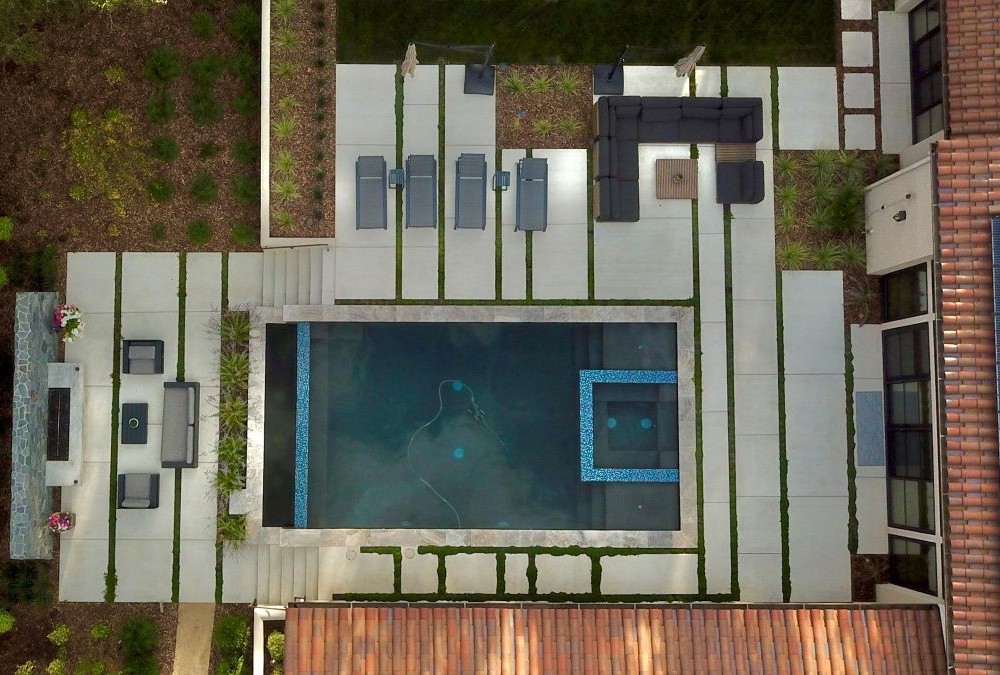
The best backyard spaces share one quality: people actually use them. A well-conceived landscape isn't simply attractive — it's organized around how a family lives, entertains, and unwinds. That distinction between decoration and intentional design is what separates a finished yard from a finished project.
Every successful design begins with a honest conversation about use. Whether the priority is large-scale entertaining, a private retreat, active family space, or some combination of all three, the layout needs to reflect those intentions from the first sketch. Without that clarity, even beautiful spaces can feel disjointed — visually complete but functionally lacking.
For most of our projects, the swimming pool serves as the organizing anchor of the outdoor environment. This means the pool cannot be designed in isolation. Placement, decking material, and circulation paths establish the spatial logic of everything around them. Planting compositions, lighting design, and grade changes are then layered in to reinforce that structure and bring the space to life after dark and across seasons.
Style is equally important to structure. A contemporary design favors clean geometry, restrained material palettes, and strong architectural lines that extend the home outward. A classical approach might draw from the symmetry and formality of French or Italian garden traditions. A more relaxed sensibility — softer edges, layered planting, gradual transitions — owes more to the English garden. What matters most is internal consistency. Whichever direction a project takes, every element should feel like it belongs to the same idea.
Circulation is often underestimated. How a person moves through the space — from the house to the pool, from the dining area to the garden, from sun to shade — should feel effortless and intuitive. Pathways and transitions that require thought or feel forced are a sign that the design hasn't fully resolved itself.
Budget shapes every decision, and the most effective designs account for this honestly from the start. Material selection, feature prioritization, and phasing strategies all need to align with the overall investment. A design that demands significant compromise during construction rarely produces a result anyone is proud of.
When all of these elements come together — purpose, structure, style, flow, and budget — the result is a space that feels genuinely complete. Nothing is an afterthought. Everything earns its place.
